
Use this calculator to plan an itemized budget to finish your basement. Adjust area, finish tier, region multipliers, rooms (e.g., bedroom, bath, office, theater), MEP (electrical, plumbing, HVAC), waterproofing, egress, and finishes. We include contractor overhead & profit, contingency, sales tax, and an optional DIY % to reduce labor.
1) Project Basics
Switching units converts inputs automatically.
Enter total slab area. Use Finish % to account for unfinished zones.
How much of the basement you plan to finish (0–100%).
Sets base cost per area incl. framing, insulation, drywall, prime/paint, basic electrical & outlets.
Enter the final multiplier (e.g., 1.18 = +18%).
2) Cost Policy
Reduce only labor portion for tasks you self‑perform.
3) Rooms & Add‑ons
4) Safety, Waterproofing & Egress
5) MEP (Mechanical / Electrical / Plumbing)
Beyond bathroom/bar/laundry defaults.
6) Finishes
Results — Itemized Estimate
| Category | Cost |
|---|---|
| Subtotal | — |
| + Overhead & Profit | — |
| + Contingency | — |
| + Permits / Inspections | — |
| + Sales Tax / VAT | — |
| Grand Total | — |
Estimator Assumptions
- Base tier includes framing, R‑13/R‑19 insulation mix, drywall, prime & single‑color paint, basic trim, code‑min outlets & lighting.
- Bathroom pricing includes fixtures set, waterproof backer where applicable, and standard exhaust fan.
- Region multiplier adjusts both labor & materials. DIY % reduces labor on applicable scopes.
- HVAC extension assumes capacity is adequate. Mini‑split priced as single zone nominal tonnage.
- Drop ceiling adds materials & labor vs drywall; good for service access.
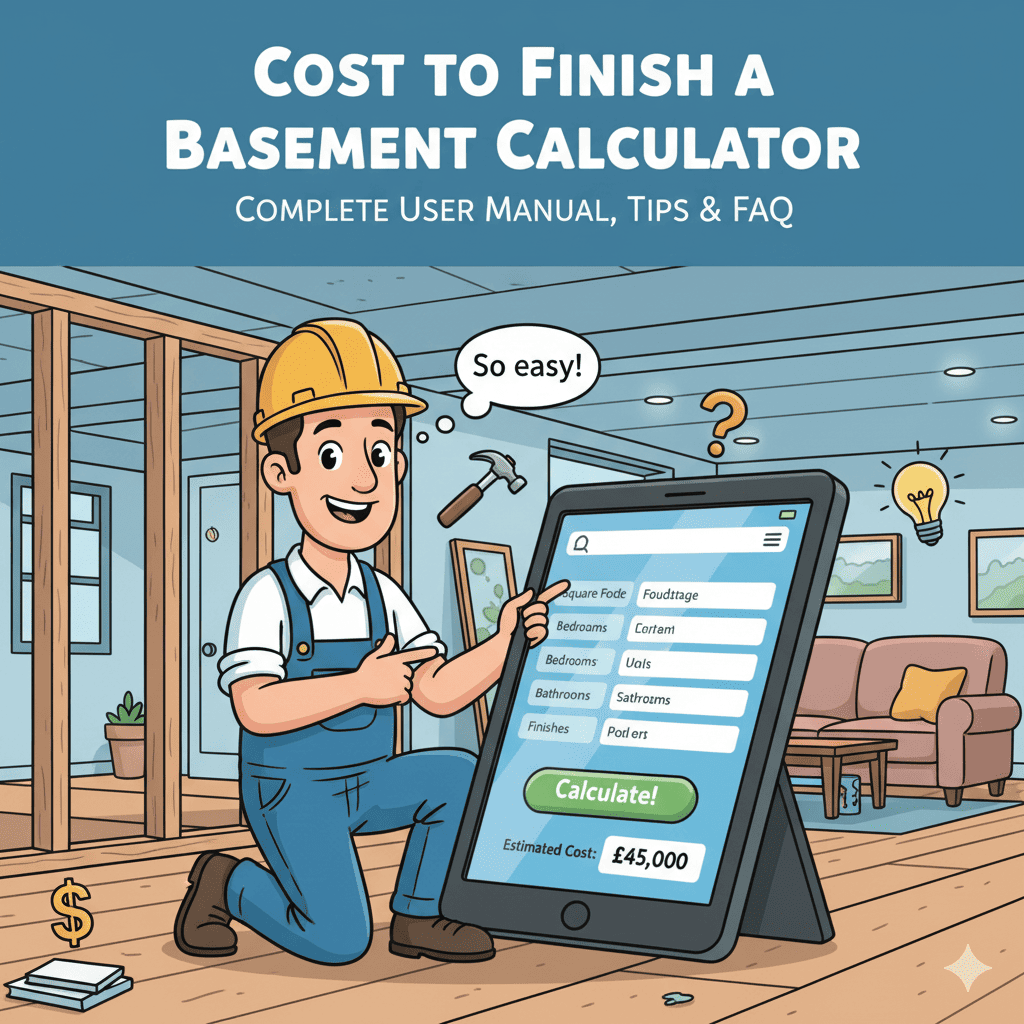
🧮 Cost to Finish a Basement Calculator — Complete User Manual, Tips & FAQ
📘 Overview
The Cost to Finish a Basement Calculator by Calcuvy helps homeowners and contractors estimate renovation costs with precision. It integrates region-based pricing, finish quality tiers, room add-ons, waterproofing, MEP systems, and finishing options — all within an intuitive, mobile-friendly interface.
This guide will help you understand how to use the calculator effectively, interpret results, and plan your basement finishing project with confidence.
🧭 How to Use the Calculator
1. Set Project Basics
Start by entering your basement area, selecting the unit (ft² or m²), and choosing your currency. Adjust the Finish Percentage to reflect only the parts you intend to finish.
Choose your Finish Tier:
- Basic – Budget-friendly, essential finishes
- Standard – Mid-range quality, most popular
- Premium – High-end materials and finishes
Then, select a Region Multiplier to account for location-based cost differences. You can even use a custom multiplier for local accuracy.
2. Define Cost Policy
Fine-tune cost assumptions:
- DIY Reduction (%) – Reduce labor cost for self-done work.
- Overhead & Profit (O&P) – Standard contractor markup (10–20%).
- Contingency (%) – For unforeseen conditions (10–15%).
- Tax/VAT (%) – Include local taxes.
- Permit Fee – Add fixed building permit costs.
3. Add Rooms & Optional Features
Enhance your estimate with:
- Bedrooms, bathrooms, office, home theater, wet bar, or laundry areas.
- Each option adds realistic, data-backed pricing.
4. Waterproofing & Safety
Select options like:
- Egress windows, sump pumps, radon mitigation, or French drains.
- Optional soundproofing packages improve comfort and resale value.
5. Mechanical, Electrical & Plumbing (MEP)
Add:
- Electrical circuits, recessed lighting, outlets, HVAC, and extra plumbing fixtures.
6. Finishes & Built-ins
Choose finish materials:
- Ceiling: Drywall or drop ceiling
- Flooring: Carpet, vinyl, laminate, or tile
- Walls: Standard or washable paint
- Built-ins: Custom cabinetry by linear foot
⚙️ Viewing & Exporting Results
After clicking Calculate, you’ll see:
- Itemized categories with costs
- Subtotal, O&P, contingency, tax, and permits
- Grand Total — shown also in the sticky footer on mobile
Export or share:
- CSV – For spreadsheets
- Print/PDF – To send or archive
- Save Preset – Store data locally
- Share Link – Copy your configured URL
💡 Tips for Accurate Estimates
- Measure precisely; verify your total area.
- Adjust regional multipliers realistically.
- Apply 10–15% contingency for surprises.
- Compare finish tiers for smart trade-offs.
- Save multiple presets for design variations.
- Factor in local permits early.
- Use DIY only for safe, cosmetic work.
🏗️ Example Calculation
Scenario: 1,000 ft² basement in a high-cost metro, standard finish, 1 bed + 1 bath
Result:
- Subtotal – $52,000
- Overhead & Profit – $7,800
- Contingency – $5,980
- Permits – $600
- Tax – $1,200
Grand Total: ≈ $67,580
A solid planning baseline before talking with contractors.
❓ Frequently Asked Questions (FAQ)
1. How accurate are these estimates?
They reflect mid-range national averages. Adjust region multipliers for local pricing.
2. Can it handle partial remodels?
Yes — use Finish % and skip sections you won’t update.
3. What’s the difference between tiers?
Basic = essential, Standard = balanced, Premium = luxury.
4. Does DIY % affect materials?
No — only labor.
5. How can I save or share?
Use Save Preset or Share Link.
6. Is it mobile-friendly?
Fully responsive and touch-optimized.
7. Recommended contingency?
10–15 %, or 20 % for older basements.
🧱 Final Thoughts
A finished basement boosts comfort and home value — but only if you budget wisely.
Use Calcuvy’s calculator to:
- Build realistic budgets
- Compare contractor quotes
- Plan for ROI and design flexibility
- Avoid hidden renovation costs
👉 Try it now at Calcuvy.com — plan smarter, build better, and finish your basement confidently.
7 Critical Factors Driving Your Cost to Finish a Basement (And How to Actually Save Money)
You’ve searched “Cost to Finish a Basement” and gotten answers from £15,000 to £90,000.
It’s useless.
Why is it impossible to get a straight answer?
It’s because you’re asking the wrong question.
The “average cost to finish a basement” doesn’t exist.
The only thing that matters is your cost.
I’m going to break down the exact factors that build the final price.
No fluff. Just the numbers.
Let’s dig in.
The Big Lie: “Average Cost”
Before we start, you should check out our guide on planning your basement layout.
Everyone wants a simple “basement finishing cost per square foot.”
They’ll tell you it’s between £30 and £60 per square foot.
So for a 1,000-square-foot basement, that’s £30,000 to £60,000.
That range is so big it’s meaningless.
It’s the difference between a new car and a deposit on another house.
The real cost to finish a basement depends entirely on your choices.
It’s a game of variables.
The Big 3: Size, Complexity, and Finish Level
If you remember nothing else, remember this.
Your price is set by three things.
1. Size: A 500-square-foot space is cheaper than a 1,500-square-foot space. Obvious.
2. Complexity: A simple, open-plan TV room is cheap.
Adding a bathroom, a wet bar, or multiple bedrooms with hallways gets expensive, fast.
3. Finish Level: Are you using basic carpet or luxury vinyl tile?
Are you installing standard recessed lighting or a custom smart-home system?
This is the “Rolex vs. Timex” factor.
Both tell time. One costs 100 times more.
Your basement finishing cost is the same.
The 7 Factors That Determine Your Final Price
Here is the exact breakdown.
Your final quote is just the sum of these seven parts.
Factor 1: Permits and Egress Requirements
This is the boring part that costs real money.
You can’t just throw up walls.
If you add a bedroom, UK building regulations require an escape route.
This usually means an egress window.
This is a safety requirement for escaping a fire.
An egress window cost alone can be £2,000 to £5,000.
ALT: An egress window well installation showing the window and ladder, a key part of the cost to finish a basement.
This involves cutting a massive hole in your foundation.
Permits themselves can be several hundred to a few thousand pounds.
Do not skip this.
If you get caught, they will make you tear it all out.
If there’s a fire and you skipped it… it’s not worth thinking about.
This is a non-negotiable part of the cost to finish a basement.
Factor 2: Framing and Drywall (The Skeleton)
This is what turns your open cave into actual rooms.
The basement framing cost includes lumber (which has wild price swings) and labour.
The more rooms you build, the more walls you need.
More walls = more money.
Drywall (or plasterboard) covers the frames.
This includes the boards, the “mudding” (joint compound), and sanding.
This part is dusty, hard work.
It’s also what makes it feel like a real room.
Expect this to be a significant chunk of your material and labour costs.
This is a fundamental LSI Cost to Finish a Basements factor (meaning it’s related to the core project).
Factor 3: Plumbing (The Cost Multiplier)
Want to keep your cost to finish a basement low?
Skip the bathroom.
Adding plumbing is often the single biggest price jump.
Why?
Your main drain pipes are usually high up, level with the ground floor.
This means you may need to cut into your concrete slab.
This is loud, messy, and expensive.
You might need a special “up-flush” toilet or a sump pump system just for the bathroom waste.
A basement bathroom can add £4,000 to £12,000 to the total price to finish a basement.
A wet bar is simpler, but you’re still running supply and drain lines.
This is a major consideration for the secondary Cost to Finish a Basements (the “add-on” costs).
Basement Feature Cost Breakdown (Estimates)
Here’s a simple table to show how features impact the average cost to finish a basement.
| Feature | Low-End Estimate | High-End Estimate | Key Cost Driver |
| Basic Open Room (1,000 sq ft) | £20,000 | £35,000 | Size, Finishes |
| Add 1 Bedroom | + £3,000 | + £7,000 | Egress Window, Framing |
| Add 1 Full Bathroom | + £7,000 | + £15,000 | Concrete Work, Plumbing |
| Add 1 Wet Bar | + £2,500 | + £8,000 | Cabinetry, Plumbing |
| Home Cinema (Basic) | + £1,500 | + £10,000+ | Wiring, Soundproofing |
Factor 4: Electrical
You need light. You need power.
This isn’t just about screwing in a lightbulb.
ALT: Modern recessed lighting layout for a basement renovation.
An electrician will run new circuits from your main consumer unit.
This includes:
- Recessed lights: The most popular choice.
- Outlets: Building codes dictate how many you need and where.
- Switches: For lights and fans.
- Specialty wiring: For a home cinema, smoke detectors, or a 240v outlet for a mini-kitchen.This is not a DIY job.Bad wiring burns down houses.The cost to finish a basement must include a licensed electrician.
Factor 5: HVAC (Breathing Room)
Your basement is underground.
It’s naturally cool, but it can also be damp.
You can’t just rely on the air from upstairs.
You’ll need to extend your existing ductwork.
This involves cutting into your main trunks and running new ducts to the new rooms.
You also need return air vents to circulate the air properly.
This prevents that “stuffy basement” smell.
If your main HVAC system can’t handle the extra square footage, you might need a “mini-split” system.
This adds thousands to your basement renovation price.
Factor 6: Insulation and Waterproofing (The Must-Haves)
This is the single most important step.
Do not. Finish. A damp. Basement.
I repeat: DO NOT.
All the money you spend on framing, drywall, and flooring will be ruined.
Mould will grow. It will smell.
Step 1: Waterproofing. Before any work starts, ensure your foundation is sealed. This might mean exterior digging or interior sealant. This is a secondary Cost to Finish a Basements that many people forget.
Step 2: Insulation. You need proper insulation against the cold concrete walls.
Rigid foam board is a common choice.
This controls the temperature and stops condensation.
This step is critical for the long-term success of your project and the cost to finish a basement.
Factor 7: Finishes (The Fun Part That Costs a Fortune)
This is where your cost to finish a basement can double.
It’s all your decisions.
- Flooring:
- Cheap: Paint the concrete.
- Good: Carpet or Luxury Vinyl Tile (LVT). LVT is great for basements as it’s waterproof.
- Expensive: Engineered hardwood or high-end tile.
- Ceiling:
- Cheap: Paint the open joists (industrial look).
- Good: A drop ceiling. It’s functional and gives access to pipes.
- Expensive: A full drywall ceiling. It looks the best but is more labour-intensive.
- Extras:
- Custom bookshelves?
- A stone veneer wall for the fireplace?
- High-end cabinetry for your wet bar?
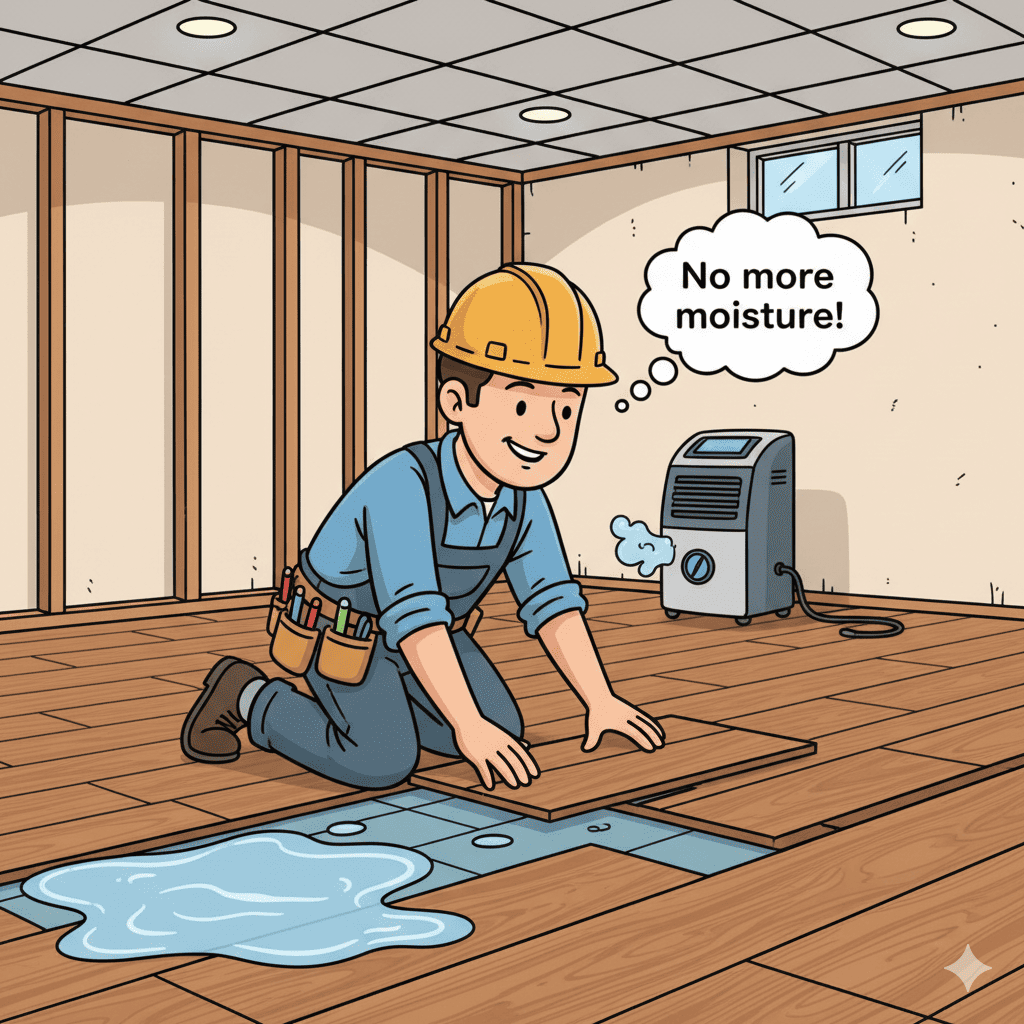
Waterproof luxury vinyl tile flooring, a popular and smart finish for a basement conversion
This is where you use a basement finishing calculator and see the numbers fly.
Your taste dictates the final price to finish a basement.
Key Facts: Home Value and Regulations
- Return on Investment (ROI): Finishing a basement is one of the few renovations that can offer a high ROI. While figures vary, a properly finished basement can often recoup 70-75% of its cost upon resale.
- Building Codes: The International Residential Code (IRC), used as a base for many local codes, dictates critical safety standards. For example, Section R310 specifies the minimum size and sill height for egress windows in basement bedrooms.
- Reference: For UK-specific regulations, the government’s Planning Portal provides guidance on building regulations for conversions, including standards for ventilation, fire safety, and structural integrity.
DIY vs. Pro (The Big Decision)
Can You Really Save with a DIY Basement Finishing Cost?
Yes. And no.
I’m a big fan of DIY, but you have to be honest about your skills.
Labour is 30-50% of the total cost to finish a basement.
So, you can save a lot.
But…
If you mess up the plumbing, you flood your house.
If you mess up the electrical, you start a fire.
If you frame a wall that isn’t straight, your drywall will look terrible.
Where to DIY (The “Safe” List):
- Demolition: Tearing out old, non-structural stuff.
- Painting: This is the easiest win.
- Flooring: Installing “click-lock” LVT or carpet tiles is very doable.
- Trim: Baseboards and door casings (if you’re patient).
Where to Hire a Pro (The “Don’t Touch” List):
- Waterproofing: Always.
- Egress Window: This involves cutting your foundation. Do not DIY.
- Plumbing: Always.
- Electrical: Always.
- Drywall Finishing: You can DIY this, but 99% of people are terrible at it. A bad mud job makes the whole room look cheap.
- Framing: If you’re not 100% confident, hire it out.
A smart DIY basement finishing cost involves being a project manager.
You hire subcontractors for the hard stuff.
You do the easy stuff yourself.
This hybrid approach is often the best balance for the cost to finish a basement.
How to Hire a Contractor and Not Get Ripped Off
Your cost to finish a basement depends heavily on who you hire.
Step 1: Get at least three quotes.
If you only get one, you have no idea if it’s fair.
Step 2: Give them the same plan.
Don’t tell one contractor you want a simple room and another you want a wet bar.
Give them all the same detailed plan.
Step 3: Ask for a line-item quote.
Don’t accept a “£40,000 for the whole job” quote.
You want to see:
- Framing: £X
- Electrical: £Y
- Plumbing: £ZThis lets you compare apples to apples.It also stops them from hiding massive profits.Step 4: Check references and insurance.Ask to see their liability insurance.Ask to talk to their last three clients.If they hesitate, run.This process protects you.It forces them to be transparent about the average cost to finish a basement for your specific project.
Key Facts: Materials and Health
- Radon Gas: Basements are the primary entry point for radon, a naturally occurring radioactive gas and a leading cause of lung cancer. The UK Health Security Agency (UKHSA) provides maps and guidance. Radon mitigation systems, which may be needed, add to the LSI Cost to Finish a Basements (like foundation work).
- Material Science: The choice of insulation is critical. Closed-cell spray foam, for example, offers a high R-value (insulation rating) and acts as a vapour barrier, but it’s more expensive than rigid foam boards. This choice directly impacts long-term heating costs and the cost to finish a basement.
A Worked Example: 1,000 sq ft Basement
Let’s Build a Fictional Cost to Finish a Basement
This example is a great partner to our guide on Cost to Finish a Basement {Cost to Finish a Basement}.
Let’s see how this works in practice for a 1,000-square-foot space.
Scenario 1: The “Man Cave” (Basic)
- Layout: Open plan. No new walls except on the perimeter.
- Bathroom: No.
- Finishes: LVT flooring, drop ceiling, standard recessed lights.
- Egress: Not needed (no bedroom).
- Work: Pro contractor.
- Estimated Cost: £25,000 – £38,000
- Main Drivers: Size, basic electrical, and drywall.
Scenario 2: The “In-Law Suite” (Mid-Range)
- Layout: One bedroom, one bathroom, one living area.
- Bathroom: Yes (mid-range fixtures, tile shower).
- Finishes: Carpet in the bedroom, LVT in the living area, drywall ceiling.
- Egress: Yes, one egress window must be cut.
- Work: Pro contractor.
- Estimated Cost: £45,000 – £70,000
- Main Drivers: Plumbing (cutting concrete), Egress Window, and more complex framing/electrical. This is a big jump in the price to finish a basement.
Scenario 3: The “Entertainer’s Dream” (High-End)
- Layout: One bedroom, one luxury bathroom, home cinema, custom wet bar.
- Bathroom: Yes (heated tile floors, glass shower, double vanity).
- Finishes: Custom cabinetry, stone countertops, engineered hardwood, soundproofing.
- Egress: Yes.
- Work: High-end general contractor.
- Estimated Cost: £80,000 – £120,000+
- Main Drivers: Custom everything. The cost to finish a basement here is limited only by your budget. The secondary Cost to Finish a Basements (like cabinetry) are now the main cost.
You can see how the basement finishing cost is a spectrum.
You choose where you want to be on it.
Key Facts: Structural and Legal Considerations
- Head Height (Headroom): Building regulations (like Part K in the UK) mandate minimum ceiling heights for habitable rooms. If your basement ceiling is too low, the cost to finish a basement will skyrocket.
- Underpinning: To gain height, you may need to “underpin” or “bench” the foundation—digging it out and extending it lower. This is a highly specialized, dangerous, and expensive structural job. This process can add tens of thousands of pounds to a project, making it a major LSI Cost to Finish a Basements.
- Reference: University College London’s UCL Institute for Environmental Design and Engineering researches the impact of subterranean development (basements) on energy use and comfort, highlighting the importance of proper insulation and ventilation.
The Final Word on Your Cost to Finish a Basement
For more ideas, see our post on Cost to Finish a Basement {Cost to Finish a Basement}.
The cost to finish a basement isn’t a mystery number.
It’s a GANTT chart of decisions.
Your final price is the sum of those decisions.
Don’t focus on the “average cost.”
Focus on your must-haves vs. your nice-to-haves.
Do you need the bathroom now, or can it be “roughed in” (plumbing ready) for later?
Can you use a drop ceiling now and upgrade to drywall in five years?
Be the master of your own budget.
Control the 7 factors, and you will control the cost to finish a basement.
Frequently Asked Questions
Does finishing a basement add value to my home?
Yes, almost always. It’s one of the best ways to add “habitable square footage” to your home. In many markets, you can expect to recoup 70-75% of the cost to finish a basement in resale value, and you get to enjoy the space in the meantime.
What is the cheapest way to finish a basement?
The cheapest way is a “rustic” or “industrial” finish.
- Seal the walls with waterproof paint.
- Paint the concrete floor with a durable epoxy.
- Paint the ceiling and all exposed joists/pipes black or white.
- Add area rugs and good lighting.It’s not a “finished” space in the traditional sense, but it’s usable and very cheap. This keeps the DIY basement finishing cost extremely low.
How long does it take to finish a basement?
Don’t believe the TV shows.
A professional job, from planning to final paint, takes 8 to 12 weeks.
This can be longer if you have permit delays or are waiting on custom items like cabinets.
Do I really need a permit for the cost to finish a basement?
Yes. 100%.
If you are adding walls, electrical, or plumbing, you need a permit.
If you don’t get one, your home insurance can deny claims (like a fire), and you will be forced to tear it out when you try to sell the home. It’s a massive financial risk.
How much does a basement bathroom add to the total cost?
This is the biggest secondary Cost to Finish a Basements.
A simple half-bath (toilet and sink) might add £3,000-£5,000.
A full bath with a shower, especially one that requires cutting concrete, will add £7,000 to £15,000 or more to the total cost to finish a basement.
References
- Planning Portal (UK Government). (2024). Building Regulations approval for conversions. Available at: https://www.planningportal.co.uk/