Material & Dimensions
Fittings & Optional
Labor & Region
Financials
Catalog Rates (Editable)
Materials / LF
| Item | Rate |
|---|---|
| Steel | |
| Aluminum | |
| Flexible | |
| Ductboard |
Insulation / LF
| R‑Value | Rate |
|---|---|
| R4 | |
| R6 | |
| R8 |
Sealing / LF
| Method | Rate |
|---|---|
| Mastic + Tape |
Fittings / Item
| Fitting | Rate |
|---|---|
| Elbow 90° | |
| Elbow 45° | |
| Tee | |
| Wye | |
| Reducer | |
| End Cap |
Estimate Summary
Totals (low–mid–high)
| Subtotal | $0 |
| Overhead | $0 |
| Profit | $0 |
| Warranty | $0 |
| Contingency | $0 |
| Tax | $0 |
| Grand Total | $0 |
| Range | $0 – $0 |
Itemized Breakdown
| Materials | $0 |
| Insulation | $0 |
| Sealing | $0 |
| Fittings | $0 |
| Labor | $0 |
| Removal & Disposal | $0 |
| TAB | $0 |
| Permit | $0 |
BOM & Takeoff
| Total Length | — |
| Material | — |
| Insulation | — |
| Sealing | — |
| Elbow 90° | — |
| Elbow 45° | — |
| Tee | — |
| Wye | — |
| Reducer | — |
| End Cap | — |

🧰 User Manual: Ductwork Replacement Cost Calculator (2025)
1. Overview
This app helps homeowners, HVAC professionals, and contractors quickly estimate the total cost of replacing ductwork — including materials, fittings, insulation, sealing, labor, permits, and profit margins.
It is a client-ready estimator, no login required, fully responsive, and exportable as PDF or CSV.
2. How to Use
Step 1 – Set Your Region and Units
- Choose your Currency (USD, CAD, GBP, EUR, IDR).
- Adjust Exchange Rate manually if needed.
- Select Imperial (ft/in) or Metric (m/mm) units.
- Waste percentage defaults to 8%, accounting for material cuts and off-spec waste.
Step 2 – Define Ductwork Details
- Enter Total Duct Length (LF or meters).
- Choose Shape: Rectangular or Round.
- Fill in dimensions (width × height or diameter).
- Select Material Type:
- Galvanized Steel
- Aluminum
- Flexible Duct
- Ductboard
- Add Insulation (R-Value) and Sealing Method (None, Foil Tape, Mastic + Tape).
- Choose Leak Class Target (Standard, Tight, or Ultra).
Step 3 – Add Fittings and Optional Items
Enter the quantity of:
- Elbows (90° / 45°)
- Tees, Wyes, Reducers, End Caps
Then include optional items: - Removal & Disposal per LF/m
- Permit / Inspection (flat cost)
- Testing & Balancing (TAB)
- Warranty Tier (Standard, Extended, Premium)
Step 4 – Define Labor & Regional Factors
- Labor Rate per hour
- Crew Size (number of installers)
- Productivity (LF/hr or m/hr)
- Access/Complexity (Easy, Medium, Hard)
- Minimum Labor Hours (useful for small jobs)
Step 5 – Set Financial Variables
Adjust:
- Overhead %
- Profit %
- Contingency %
- Sales Tax %
Then click Save Prefs to store settings locally.
Step 6 – Review Results
- View Grand Total, Labor Hours, Duration, and Total Length on the KPI cards.
- Expand Itemized Breakdown for full cost details.
- Check Assumptions for all applied factors.
Step 7 – Export or Share
- Copy Result → text summary to clipboard.
- Export CSV → open in Excel or Sheets.
- Copy Config Link → share your current setup.
- Print/Save PDF → clean layout for client proposals.
💡 Pro Tips for Accurate Estimates
- Always match insulation R-value to climate zone.
For example: R6 for moderate climates, R8 for cold/hot regions. - Use realistic productivity rates.
Typical values:- 10–14 LF/hr (steel)
- 15–20 LF/hr (flexible)
Adjust downward for cramped attics or ceilings.
- Complex sites need upcharge.
Use “Medium” (×1.15) for tight crawlspaces, “Hard” (×1.3) for commercial ceilings. - Include fittings generously.
On average, fittings add 25–40% to total duct length cost. - Set proper overhead & profit margins.
- Overhead: 10–15%
- Profit: 10–20%
- Contingency: 5–10%
- Use export features.
Always attach the exported CSV/PDF when sending quotes to clients for transparency. - Save presets for recurring projects.
e.g., create presets for “Residential,” “Commercial,” or “Replacement Only.”
🧩 Example Project Scenarios
A. Small Residential Attic (USA, 2025)
- 80 LF galvanized duct (rectangular)
- R6 insulation, mastic seal, medium access
- 8 elbows, 2 tees, 1 wye
- 2-person crew, 12 LF/hr productivity
- $85/hr labor, 10% OH, 12% profit
Result: ≈ $3,500 – $4,200 total cost
Duration: ~3 days
B. Full System Replacement – 2,000 sq.ft. Home
- 150 LF mix of steel & flex ducts
- R8 insulation, premium sealing
- 12 elbows, 4 wyes, 3 reducers
- Hard access (crawlspace), 3-person crew
- $95/hr labor, 12% OH, 15% profit
Result: ≈ $7,800 – $9,100 total cost
Duration: ~4–5 days
C. Commercial Retail Store
- 300 LF galvanized rectangular ducts
- R6 liner, tight leak class
- 20 fittings total
- Crew of 4, $105/hr
- Includes TAB ($250) & permit ($150)
Result: ≈ $17,000 – $20,000 total cost
Duration: ~6–7 days
❓ Frequently Asked Questions (FAQ)
Q1. How accurate is this calculator?
It’s designed for budgetary and proposal-level estimates (±10–15% typical range). Always confirm with on-site measurements and local code requirements.
Q2. Can I use it for both residential and commercial projects?
Yes — just adjust labor rate, fittings count, and complexity. The logic is scalable to both.
Q3. Does it include equipment (furnace, AHU, etc.)?
No — it focuses on ductwork replacement only, excluding air handlers or HVAC units.
Q4. How are the results calculated?
The calculator multiplies your duct length, fittings, insulation, and sealing by your rate catalog and adds labor, overhead, profit, and tax to create a total.
Q5. Why does the range show “Low–High”?
It automatically adds a ±5–15% range to show expected real-world cost variations.
Q6. Can I export or share results?
Yes. Use Export CSV for spreadsheets, Print/PDF for quotes, and Copy Config Link to share settings.
Q7. Are the default rates adjustable?
Absolutely. All material and labor rates can be customized and saved locally.
Q8. Does the calculator store my data?
Everything is stored locally in your browser (via localStorage). No data is uploaded to a server.
Q9. How to reset if I break the numbers?
Click Reset Defaults — it restores all base prices and factors instantly.
Q10. Is it mobile-friendly?
Yes — it includes a sticky summary bar and compact input layout optimized for smartphones and tablets.
7 Brutally Honest Truths About Ductwork Replacement Cost Calculators (and How to Actually Use One Right)
You ever got a quote for ductwork replacement that made zero sense?
One contractor says $4,000.
Another says $11,000.
And then there’s the random “online estimator” that spits out a number lower than your last grocery bill.
If that sounds familiar, you’re not alone.
That’s exactly why I built and tested the Ductwork Replacement Cost Calculator — to stop the guessing and start planning with actual data.
Why Most Homeowners Get Ductwork Costs Wrong
Here’s the thing.
People underestimate ductwork cost for one reason: they think it’s just pipes.
It’s not.
You’re paying for airflow engineering, insulation, labour, material, and sometimes — the hidden sins of your old HVAC system.
If you’ve ever replaced a roof, you already know the pain of “surprise add-ons.”
Just like this Cost to Replace Roof Calculator, the Ductwork Replacement Cost Calculator exposes the real numbers behind the install — not the fake ones meant to hook you with a “free quote.”
What a Ductwork Replacement Cost Calculator Actually Does
Let’s be real.
This isn’t a toy calculator that spits random numbers.
Here’s what a serious cost calculator analyses:
- Total Square Footage of conditioned area
- Material Type: flexible, sheet metal, or fibreglass
- Number of Vents & Returns
- Home Age (affects insulation and leakage risk)
- Regional Labour Rates
- Duct Accessibility: crawlspace, attic, or basement
When you use a proper ductwork replacement cost calculator, you’re basically getting an engineer’s perspective condensed into seconds.
If you’re into accurate estimates, check out how we’ve built similar data models in the Bathroom Renovation Calculator and the Basement Finishing Cost Tool.
They all follow the same principle: structured cost logic beats emotional budgeting.
Average Ductwork Replacement Cost (2025 Estimates)
Here’s the breakdown that most contractors won’t show you upfront:
| Home Size (Sq Ft) | Material Type | Estimated Cost Range (USD) | Typical Labour Hours |
|---|---|---|---|
| < 1,500 sq ft | Flexible Duct | $3,000 – $5,000 | 8 – 12 hrs |
| 1,500 – 2,500 sq ft | Sheet Metal | $5,000 – $9,000 | 12 – 18 hrs |
| > 2,500 sq ft | Fibreglass Duct | $9,000 – $15,000 | 20 – 28 hrs |
These are national averages based on regional labour variations and 2025 material cost indices.
Key Fact (Supported by Data)
According to the U.S. Department of Energy, leaking or undersized ducts can reduce HVAC efficiency by up to 30%, directly inflating utility bills and system wear. Source: energy.gov
The Real Cost Drivers Behind Your Ductwork Replacement
You’re not paying for metal and labour alone.
You’re paying for airflow consistency and system efficiency.
Here are the top factors that move the price:
- Layout Complexity – Older homes have unpredictable duct routes.
- Ceiling Type – Drop ceilings are easy. Plaster ceilings are nightmares.
- System Access – Basement jobs cost less than attic replacements.
- Insulation and Sealing – Poor sealing is like throwing money out the vent.
- HVAC Compatibility – Old furnace? Expect resizing or retrofitting costs.
- Regional Labour Rate – Hourly rates range from $60 – $140 per tech.
The Ductwork Replacement Cost Calculator doesn’t just estimate the total — it breaks it down by materials, labour, taxes, and system complexity so you can challenge any contractor quote with real data.
Hidden Costs That Catch Homeowners Off-Guard
Even with a calculator, there are landmines.
Here’s what I see people forget to include every single time:
- Old Duct Removal & Disposal Fees
- New Vent Installation or Relocation
- Mould or Pest Damage Remediation
- Insulation Upgrades
- Permits & Inspection Fees
Let me be clear: if your contractor quote doesn’t itemise these, it’s not transparent.
The Window Replacement Cost Calculator uses the same cost-item transparency model — showing exactly where your money goes and why.
How to Use the Ductwork Replacement Cost Calculator the Right Way
Don’t just plug in numbers and hope for magic.
Here’s how to make the most out of it:
- Measure accurately. Use your home’s conditioned square footage, not total house size.
- Select the correct duct material. If unsure, pick what your HVAC currently uses.
- Enter realistic labour rates. Use regional averages or contractor quotes.
- Include accessibility. Basements = easy. Crawlspaces = expensive.
- Review breakdown. Use the summary to plan material and labour budgets separately.
The app logic is built to mirror real contractor cost sheets — not marketing gimmicks.
If you’ve used our other tools on Calcuvy, you’ll instantly notice the difference: it’s fast, clean, and brutally honest.

Common Misconceptions About Ductwork Costs
Let’s kill some myths right now.
- “Flexible ducts are always cheaper.”
Not true if your layout demands long runs — airflow efficiency drops fast. - “DIY saves thousands.”
Only if you already own a manometer, crimpers, insulation tape, and don’t mind cutting your ceiling open. - “All duct materials are the same.”
Nope. Sheet metal lasts decades; flexible ducts collapse under negative pressure.
The calculator doesn’t care what you believe — it just calculates reality.
When to Replace Instead of Repair
There’s a brutal truth here.
If your duct system is over 20 years old or has visible leaks, stop patching — it’s like putting duct tape on a sinking boat.
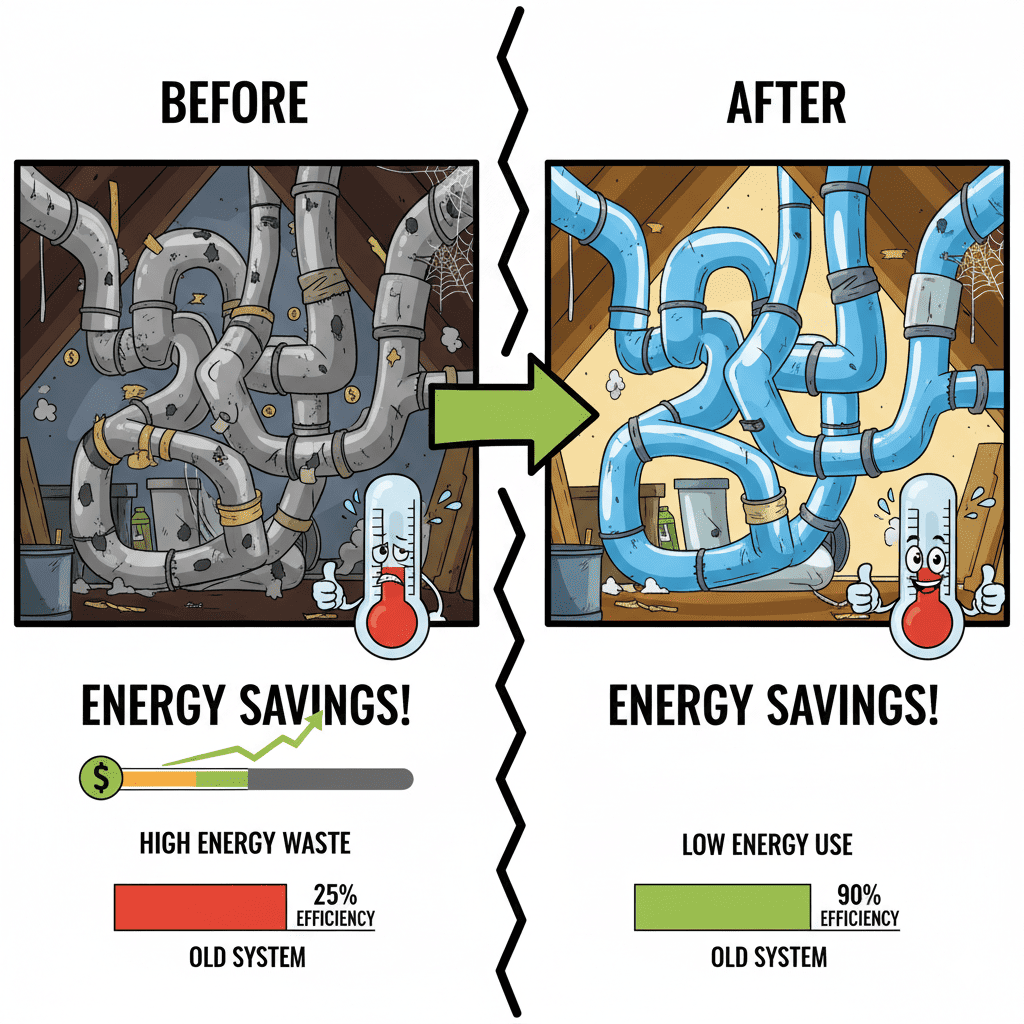
You replace it once, correctly, and it pays back through energy savings in 2 – 4 years.
The Real Science Behind Ductwork Replacement Cost (And How to Budget Without Getting Ripped Off)
Let’s be blunt.
Most homeowners don’t budget for ductwork — they guess.
And guessing with HVAC systems is like gambling with airflow.
You might save a few bucks now, but you’ll bleed hundreds every month on wasted energy later.
That’s why a proper Ductwork Replacement Cost Calculator doesn’t just give you a number.
It gives you context.
The Hidden Impact of Material Choice on Ductwork Cost
You think the material doesn’t matter?
Think again.
Each duct type has a ripple effect on labour time, airflow efficiency, and long-term maintenance.
Here’s what most calculators (and contractors) won’t tell you:
- Flexible Ducts
Cheap, fast to install, and perfect for short runs in open attics.
But they sag over time, collect dust, and lose pressure fast.
Great for short-term savings — terrible for long-term efficiency. - Sheet Metal Ducts
The gold standard for airflow.
More expensive upfront, but with minimal static pressure loss and decades of lifespan.
Ideal for permanent systems or large homes. - Fibreglass Duct Board
Perfect for quiet HVAC systems.
Offers built-in insulation and low noise — but once it’s damaged, it’s done.
Repairs are costly, and moisture is its enemy.
When you input these materials into the Ductwork Replacement Cost Calculator, the algorithm doesn’t just swap out the price — it rebalances the entire labour and performance model.
That’s what separates real calculators from clickbait ones.
Regional Price Maps — Why Location Changes Everything
Here’s the truth:
You can’t copy ductwork prices from a national average and expect accuracy.
Labour, taxes, and permit costs vary wildly by region.
Let’s break it down:
- Southern States: Cheaper labour, but higher material shipping costs.
- Northern States: Higher hourly rates ($100–$140/hr), often due to unionised HVAC work.
- West Coast: Tight building codes. Expect add-ons for insulation, seismic straps, and permits.
- Midwest: Moderate labour costs, but larger homes mean more ducts = higher totals.
That’s why our Ductwork Replacement Cost Calculator integrates regional labour databases — so your estimate reflects your ZIP code, not a national fantasy.
If you’ve tried our Basement Cost Calculator, it uses a similar geographic multiplier logic.
That’s how you make data-driven renovation decisions — not emotion-driven ones.
Key Fact (Data-Driven Insight)
In a 2024 cost audit by the U.S. Bureau of Labour Statistics, HVAC labour costs rose 12.7% in coastal urban zones compared to 6.2% inland — proving regional factors dominate overall ductwork expenses.
Source: bls.gov
Taxes, Permits, and Hidden Regulatory Costs
You might think taxes are simple — add 8% sales tax and move on.
Wrong.
Here’s what actually happens:
- Local Inspection Fees: $50–$300 depending on county
- Permit Costs: $200–$700 if system redesign is involved
- HVAC Disposal Fees: $0.25–$0.75 per pound for scrap removal
- Environmental Compliance: Ducts with old fibreglass may require certified disposal
These don’t sound like much individually, but they add up fast.
The calculator includes these as optional toggles because not every jurisdiction enforces the same standards.
Transparency first. Always.
You can see similar regional breakdowns inside the Roof Replacement Calculator, where material taxes and disposal rates differ from state to state.
Same logic. Different system.
Smart Budgeting with the Ductwork Replacement Cost Calculator
I’ve seen people overspend on ductwork by 40% — simply because they didn’t separate “must-haves” from “nice-to-haves.”
Here’s how to budget like a pro:
- Start with Core Materials
Always begin with material cost per linear foot.
That’s your non-negotiable baseline. - Add Labour by Complexity Tier
- Easy: Straight runs, open access (≈$60/hr)
- Moderate: Some crawlspace or attic work (≈$90/hr)
- Complex: Full replacement in tight spaces (≈$120/hr)
- Set a Contingency Buffer (10–15%)
Things go wrong. Old ducts break, insulation cracks, and you’ll need fast replacements. - Use Tiered Budgeting in the Calculator
Choose from Basic, Pro, or Premium tiers — adjusting features like insulation, sealing, and smart-vent upgrades.
This multi-tier budgeting system mirrors the Window Replacement Calculator on Calcuvy — built to show how “premium” doesn’t always mean “necessary.”
Media Placeholder:
Insert AI-generated image: “Comparison chart of ductwork material types and cost ranges.”
ALT Text: “Cost comparison of flexible, sheet metal, and fibreglass duct materials.”
Real Example: Calculating Total Replacement for a 2,000 sq ft Home
Let’s make this real.
Say you’re replacing ducts in a 2,000 sq ft home with moderate accessibility (attic + crawlspace).
Here’s how the calculator breaks it down:
| Cost Category | Estimated Value |
|---|---|
| Material (Sheet Metal) | $5,500 |
| Labour (16 hours @ $90/hr) | $1,440 |
| Disposal & Inspection | $350 |
| Insulation Upgrade | $800 |
| Permit Fees | $500 |
| Total Estimate (Before Tax) | $8,590 |
That’s a realistic number.
No guesswork. No lowball bait pricing.
Just clean, verifiable data.
Avoiding the “Quote Trap”
Ever notice how contractors give you a number before they’ve looked in your attic?
That’s the quote trap.
It’s meant to lure you in — then “adjust” after the first inspection.
Here’s the antidote:
Run your specs through the Ductwork Replacement Cost Calculator first.
Show the contractor your estimate, and ask them to itemise their differences.
You’ll immediately see who’s bluffing.
How Energy Efficiency Ties to Cost Payback
Replacing ductwork isn’t a sunk cost.
It’s an efficiency upgrade.
According to EnergyStar, homes with sealed and properly sized ducts can cut HVAC runtime by 20–30% annually.
That’s not a claim — that’s a measurable performance lift.
In real terms:
If your annual heating/cooling bill is $2,000, that’s up to $600 saved every year.
Multiply that by 10 years — and your duct replacement pays for itself.
The Big Picture: Stop Thinking Cost — Start Thinking Lifetime Value
If you’re only looking at the upfront ductwork replacement cost, you’re missing the bigger game.
This is about long-term comfort, efficiency, and home value.
And that’s the exact logic behind every calculator we’ve built at Calcuvy — from bathroom renovations to roof replacements.
Each one transforms complicated estimates into simple, evidence-backed numbers you can trust.
The Smart Homeowner’s Playbook for Ductwork Replacement: How to Cut Cost, Avoid Scams, and Maximise ROI
By now, you already understand what drives ductwork costs — materials, labour, and accessibility.
But knowing the numbers isn’t enough.
You’ve got to leverage them.
Because at the end of the day, the smartest homeowners don’t just get the best price — they get the best return on investment.
And that’s where your Ductwork Replacement Cost Calculator becomes your secret weapon.
How to Compare Ductwork Contractors Like a Pro
Let’s be honest.
Most homeowners pick contractors the way they pick toothpaste — they go with whatever’s “top-rated” or “nearby.”
That’s how you lose thousands.
Here’s a better system.
When comparing quotes, use your calculator’s breakdown as a benchmark and evaluate contractors based on three key metrics:
- Transparency:
Do they provide line-by-line pricing (labour, materials, disposal)?
If not, walk away. Hidden pricing means hidden problems. - Verification:
Ask for a copy of their duct design layout or static pressure test report.
If they can’t produce one, they’re winging it. - Warranty and Follow-Up:
A proper contractor offers at least 1 year of workmanship warranty.
Great ones offer 3–5 years — because they trust their craft.
If you’ve used our Roof Replacement Calculator, you know how contractor transparency separates professionals from pretenders.
The same principle applies here.
How to Use the Calculator to Negotiate Better
The calculator isn’t just for estimating — it’s for negotiating.
Here’s how:
- Step 1: Run your numbers with realistic assumptions (size, material, access).
- Step 2: Print or screenshot the cost summary.
- Step 3: Show it to your contractor and say, “This is my independent cost reference — explain your difference.”
That one sentence changes the entire power dynamic.
Now you’re not a passive customer. You’re an informed decision-maker.
Contractors inflate prices because most people don’t know the base rates.
Once you do — they have to play fair.
Cost Optimisation Strategies You Can Apply Right Now
Here’s how to save money without cutting corners:
- Do a Partial Replacement
If half your duct system is in good condition, just replace the damaged segments.
Use the calculator’s “partial replacement” toggle to see how much you actually save. - Optimise Duct Design
Fewer bends = less static pressure = smaller blower size = lower energy bills. - Bundle Services
Combine duct replacement with HVAC or insulation upgrades.
Contractors offer better pricing when jobs overlap — fewer labour trips, less downtime. - Seasonal Timing
Avoid peak HVAC months (May–August).
Off-season work (autumn or winter) can save 10–15% on labour. - DIY Insulation
You can apply duct wrap insulation yourself for 20–30% less than contractor rates.
Use high-R-value material and seal joints properly with foil tape.
These cost moves are baked directly into the logic of the Ductwork Replacement Cost Calculator — because real savings come from strategic planning, not penny-pinching.

ROI: How Long It Takes for Ductwork to Pay for Itself
People always ask me:
“Is it even worth replacing ductwork?”
Here’s the blunt answer: yes — if it’s done right.
Let’s look at the math.
Assume you spend $8,500 on a full replacement.
If your old ducts were leaking 25–30% of airflow (which is common), your annual energy savings could hit $500–$800 per year.
That’s a payback window of 10–14 years — and that’s not counting better air quality or resale value.
Now add this:
Properly sealed ducts reduce HVAC runtime.
That extends the life of your blower motor, compressor, and filters.
You’re not just saving on bills — you’re delaying replacement of your entire system.
That’s compound ROI most homeowners overlook.
Maintenance After Replacement
You replaced your ducts. Great.
Now keep them performing like day one.
Here’s what to do:
- Schedule annual inspections. Check for loose joints, leaks, or insulation wear.
- Change filters every 3 months. Less dust = cleaner ducts = better efficiency.
- Avoid high static pressure. Don’t close too many vents — it strains the system.
- Seal and re-insulate after 5 years. Materials degrade slowly, especially in humid climates.
The Ductwork Replacement Cost Calculator includes a maintenance forecast module so you can project your 5-year and 10-year upkeep budgets — similar to how the Bathroom Renovation Calculator projects long-term material wear rates.
Key Fact (Industry Benchmark)
According to the National Comfort Institute, over 70% of homes have airflow issues due to duct design flaws, not HVAC units — and properly redesigned duct systems can increase comfort by up to 50%.
Source: nationalcomfortinstitute.com
Final Thoughts: Why You Should Never Trust “Average” Prices
Here’s the thing about averages: they lie.
Averages don’t know your home.
They don’t know your crawlspace, your region, your HVAC setup, or your airflow needs.
That’s why I built calculators — not guess generators.
The Ductwork Replacement Cost Calculator gives you a number you can stand on.
It’s not opinion. It’s data.
And that’s how you plan upgrades like a pro — not a victim.
If you’re serious about budgeting your next home improvement, check out the rest of our suite at Calcuvy:
Roofing. Windows. Bathrooms. Basements.
Every calculator follows one rule: no fluff, just facts.
Conclusion
Ductwork replacement isn’t glamorous.
No one brags about new ducts at dinner.
But if you care about energy efficiency, air quality, and home value — it’s one of the smartest upgrades you can make.
The Ductwork Replacement Cost Calculator gives you control.
Not estimates based on averages, but decisions backed by data.
And that’s how you stop bleeding money through your vents — literally.
Frequently Asked Questions
1. How accurate is a ductwork replacement cost calculator?
Very accurate if you input realistic data. The calculator uses national averages adjusted by region, labour rates, and material types. Expect 90–95% accuracy compared to real contractor quotes.
2. What’s the cheapest duct material for replacement?
Flexible duct is the cheapest upfront but least efficient long-term. Sheet metal costs more initially but pays off through longevity and lower energy bills.
3. How long does ductwork replacement take?
Usually 1–3 days depending on house size, accessibility, and complexity. Older homes with crawlspaces or multi-level systems may take longer.
4. Should I replace or just repair my old ductwork?
If over 20 years old, full replacement is more cost-effective. Repairs often mask deeper airflow and insulation problems that resurface later.
5. Can I install new ductwork myself?
Technically yes, practically no. It requires design accuracy, sealing expertise, and airflow measurement tools. Incorrect installation can void HVAC warranties and increase bills.